Commissioning Testing vs. Type Approval Testing of a BWMS: What’s the Difference?
Ballast water management systems (BWMS) go through two very different kinds of testing before they are trusted to work onboard a ship. The names sound alike, and they are often confused, but the two tests have very different purposes, different people running them, and very different levels of difficulty.
Type approval testing: proving the design works
Type approval testing is where a BWMS model earns its right to be sold. It is a one-time process for each release of a BWMS, managed by the manufacturer under tightly controlled, prescribed conditions, and overseen by a third party working on behalf of a flag Administration. In these tests, the BWMS must prove it meets the IMO D-2 discharge standard for organisms in the ≥50 µm and 10–50 µm size classes and for indicator microbes. It also has to prove it can do so repeatedly, across the water conditions and operating limits the manufacturer claims. At least fifteen times in a row, under the harshest possible conditions, and without failing once. If a BWMS fails, the tests start over - no excuses.
The testing is demanding. It involves environmental, land-based, and shipboard testing, with sampling and laboratory analysis, strict test protocols and detailed documentation. Test teams spend long periods onboard working in the real conditions of a working ship. It takes months of planning and execution, costs millions, and a failed test sends a manufacturer back to the start. That difficulty is intentional: type approval is meant to ensure that the system performance is proven and repeatable.
Commissioning testing: proving the installation works
Commissioning testing asks a much narrower question: does this specific system, installed on this specific ship, work as it was approved to? It is a one-time check after installation, and it is carried out by an independent provider, not the manufacturer.
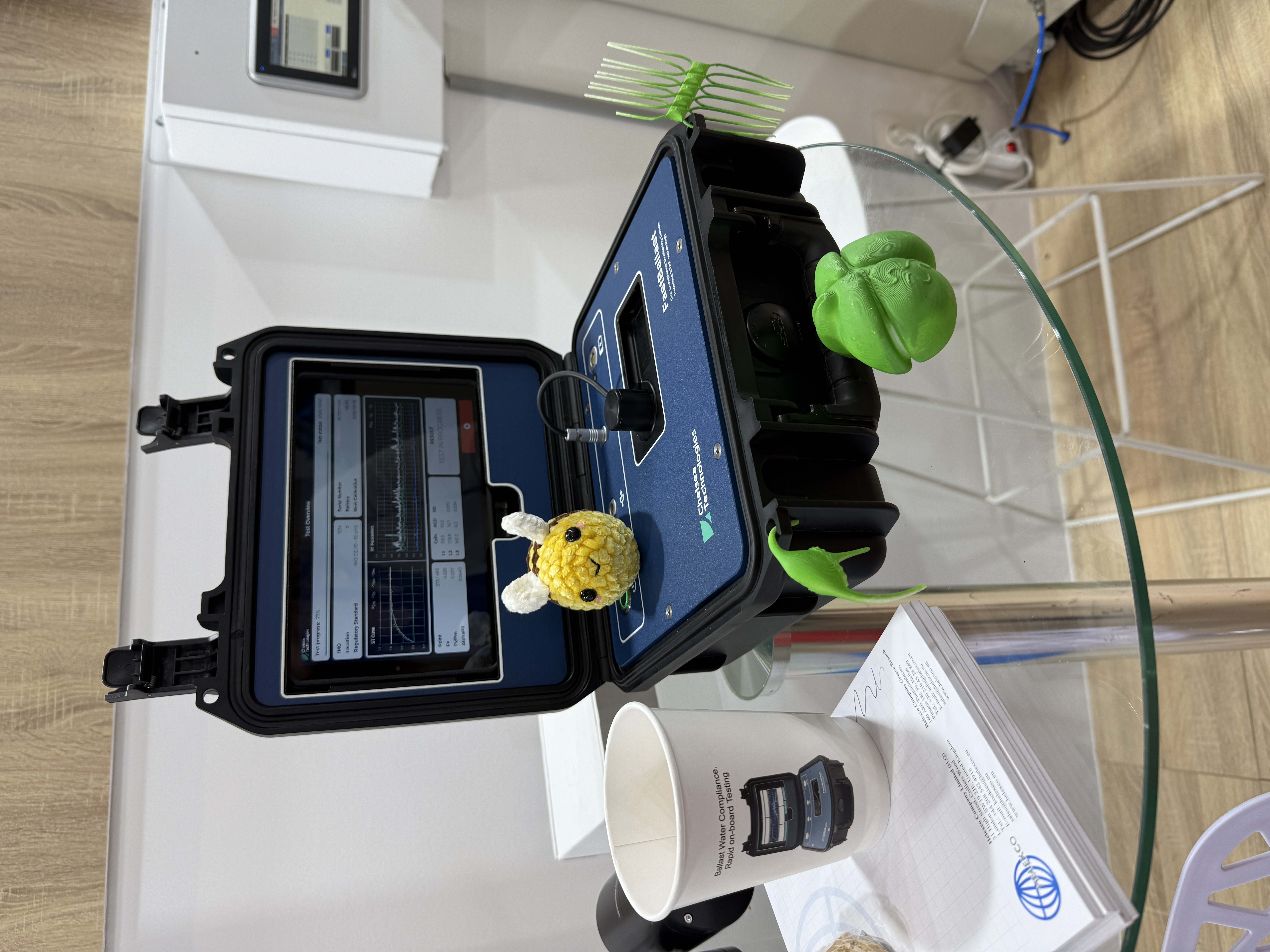
The goal isn’t to re-prove the technology. That was settled during type approval. Commissioning testing confirms that the installation is correct, that the system operates as designed, and that its treated discharge meets the D-2 standard. IMO’s guidance on commissioning testing, which has applied to newly installed systems since 1 June 2022, allows indicative analysis using compliance monitoring devices for the sampling and analysis.
Why commissioning testing is the easier test
The two tests differ in several practical ways, but the key point is the difference in difficulty. Type approval is a rigorous gauntlet that a design has to survive. Commissioning testing is a verification step. A system that has already been through type approval has already shown it can do the job, so commissioning testing only needs to confirm that your ship’s installation hasn’t compromised that performance. It comes down to the strength of each challenge and the number of times the test has to be repeated for success: type approval testing has verified, significant, levels of challenge organisms and environmental stressors and must be passed at least twenty times in a row (15 land-based and 5 shipboard); commissioning testing only needs to pass once in the waters where the ship is, without any specific requirement for challenge conditions. Easy peasy!
A properly installed system should pass
If a BWMS has been installed correctly, according to the manufacturer’s requirements, with the right piping, power, controls, sampling points and settings, it should have no trouble passing commissioning testing. The test is not meant to be a trap. When a system does fail, the cause is almost always practical: contamination of the tanks or piping during installation, an installation error, a sensor or control that was set up wrongly, or a sampling point in the wrong place. Those are fixable problems, and they are exactly what commissioning testing is meant to find early, before they become compliance problems later in the vessel's life.
That’s why preparation matters more than anything else. Before the independent provider arrives, make sure the system has been installed and started up according to the manufacturer’s instructions, that sensors are calibrated, that sampling points are accessible and correct, and that the crew knows how to operate it. A system that is ready should pass without drama.
The bottom line
Type approval testing proves that a BWMS design works, and it is difficult by design. Commissioning testing proves that a particular ship’s installation works, and it is meant to be straightforward. If your system has been installed correctly, you can expect to pass.
Need help preparing for commissioning testing or planning a BWMS installation? Contact Simplify Ballast to talk it through.